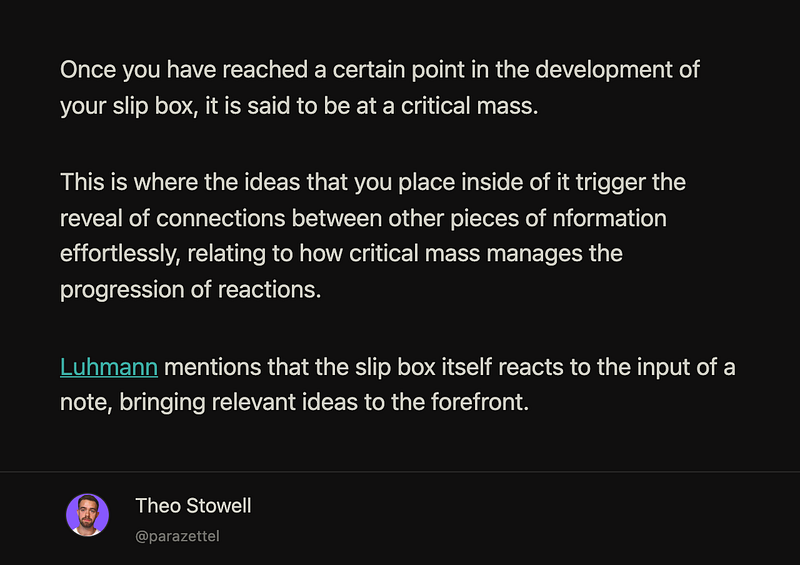
One of the first atomic notes that I ever wrote in my Obsidian-based Zettelkasten was about critical mass — how a Zettelkasten becomes a “sparring partner” only when it reaches a critical mass of notes.
It was inspired by Sönke Ahrens’ How to Take Smart Notes, which is a book all about Niklas Luhmann’s Zettelkasten.
The other day, three years on from writing this note, I had a really visceral moment of realisation about how powerful this is, and so I wanted to take a moment to tell you about it in this piece today…
Inside my community (which I’m opening up again soon), I was doing a video talking about the idea.
The video, however, wasn’t about critical mass in a PKM-education context. Instead, I was talking about how I use my Zettelkasten for idea generation and development whilst writing newsletter issues.
During my demonstration, I was showing how I was writing a newsletter issue about momentum, or reaching critical mass in projects in life.
My point was that once you’ve reached a certain point, forward motion is pretty much conserved, or even slowly compounding and building speed. An example is found in that I get a base viewership on my writing and videos every day, whether I post or not right now.
This is because in the past I’ve done the grunt work of publishing whilst nobody was reading and watching, enough times for the various algorithms to pick me up and distribute me.
The details of the idea are besides the point here — the issue is out on Fundamentalised, and you can read it if you like.
But during this demonstration, I wanted to show my audience how I could generate depth in my idea about critical mass using notes that I’d written that I’d completely forgotten about.
So I came to my Obsidian vault and thought for a moment before going ‘uhhh….critical mass’ whilst typing the words into the quick switcher.
And the note at the top of this piece popped up.
I realised that I was watching the Zettelkasten in action — now, from this, I had another idea I could address in my newsletter, but as well as this I had an entire suite of ideas for a new PKM-education article.
Which article? You’re reading it right now. An entire piece, coming from a coincidental suggestion from a note that I’d written three years ago.
Very powerful.
So how do you build a Zettelkasten to critical mass?
To be honest, it’s not a quick process.
Every time you have an insight or thought worth keeping, you need to distil it into something atomic that can be contained in one note and linked to the rest of your thoughts in your Zettelkasten (again, the note at the top of this article is an example of this).
You have to go somewhat out of your way to make it work, taking your notes from your various capture locations, highlights from the books you’ve read and your own thoughts, synthesising them into this interconnected web.
But like with anything, from exercise to mindfulness, once a critical mass is reached, a little effort provides disproportionate output. It’s not necessary to write as many atomic notes and link them all together. The ideas arise more easily, sooner after looking for suggestions and connections.
Every now and again, you can write something new, but the power now comes more from looking inside your Zettelkasten for context you’d forgotten about, which you can then use in your projects.
After all, your mind was never designed to hold all of this detail — instead, you can put it into a tool, like Obsidian, using a method like the Zettelkasten, and breathe a sigh of relief…
Because now you can focus on your creative or professional work, safe in the knowledge that you’ve got a partner by your side that connects thoughts even when you can’t, and that grows in effectiveness the more you contribute and allow it to mature.
Thanks for reading!