
Back in November, as I swanned through Vietnam (working hard or hardly working?), I published my most successful YouTube video of the last 12 months.
It’s called ‘Breaking Down the Obsidian CEO’s Personal Vault System’ and is hovering at almost 6,000 views (not bad for a channel of almost ten times fewer subscribers)…
Today I thought I’d revisit that topic as I recently, in my private community, demonstrated how to implement Claude Code in a vault that hasn’t experienced it yet (Steph Ango’s vault was the one I chose for the demonstration).
We’ll start with the structure for organisation that Steph uses, and finish with the reason why you probably shouldn’t copy his vault exactly (even though he’s the CEO)…
A focus on Properties
Now for one, I thought that I was property and template heavy when I was working in my notes, but I’m nothing when compared to Steph.
There are over 50 templates for notes, for every category of thing, from ‘Game Studio’ to ‘Restaurant’ to ‘Job Interview’. He’s also created Bases for each template, meaning like notes can be viewed in one place and, if desired, these lists embedded into other notes for further reference.
And this highlighted how powerful that Properties and underneath, YAML metadata can be as a method of note organisation.
Because aside from using these templates, Steph doesn’t ‘organise’ his notes much in the way of using conventional folders.
Instead, he relies a lot on links, alongside Properties…
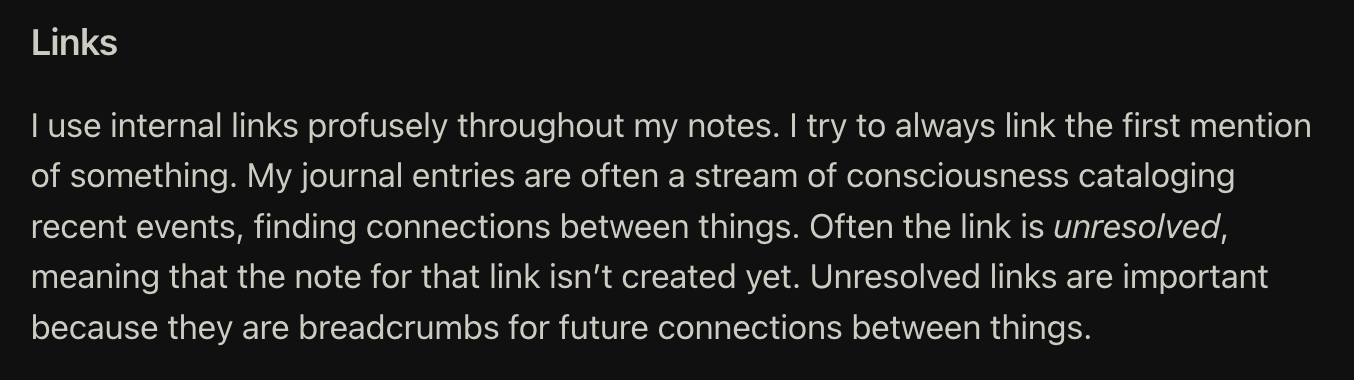
And this makes sense when you realise that organising through properties is the most conventionally logical organisation structure, and wikilinks the least logical i.e. reliant on the user’s experience and personal memories and knowledge to understand the relevance of such links.
It’s dynamic, with everything linked to everything, from everywhere - the Properties contain wikilinks, as well as the note content, and the bases bring these links in, and relevant properties, so that navigating between related content is very easy.
Thus Steph only makes notes in one of a few folders, and relies on properties and Bases to make sense of the organisation from a structural perspective.
Examples of such folders are the Periodic Notes, the References (which I imagine is where the templated types of notes live, like ‘Brown butter nectarine tart’ and more), and ‘Notes’, which is where all the active thinking and development of thoughts and ideas happens.
Aside from this, other folders are storage notes for Base and note templates, keeping them separate from the main workspace of the vault.
Is this going to work for you?
This vault template is simple, but built for someone who has a very first-principles approach to knowledge management.
You don’t just wake up one day and have a great idea of how to manage properties, templates and bases, and how to add in-context links to all the notes and resources you have in your vault.
Instead, you might prefer to use more folders to organise things, with less linking and fewer bases.
That’s the route that my system PARAZETTEL takes, organising notes through not only linking and properties, but by the over-arching PARA Method from Tiago Forte.
–
The bottom line - when you’re investigating other people’s vaults and systems, it’s not all going to make sense in your head right away. And that’s fine, as you’re not obliged to take notes in exactly the same way another person does.
(In fact, this was the subject of one of my first popular articles on the topic of note-taking)
Find a simple starting point that you can go from, and then after this, build elements into your vault only as and when you need them.
Inspired by Steph’s vault, I’m taking a more templating and Base-heavy approach as the Obsidian web clipper and reader improves and AI can navigate and process the resources that I capture to my vault more readily.
But you might not be ready for this as of right now, instead you might need to see the following video. AI is very powerful, and now there’s really only one thing that makes sure that you’re going to be able to stand out from all the AI synthesis and posting that you’re doing…
Article aside, my YouTube is a really good place to see me walk through things, from vault demos to theory and insights in that perspective.
Thanks for reading!