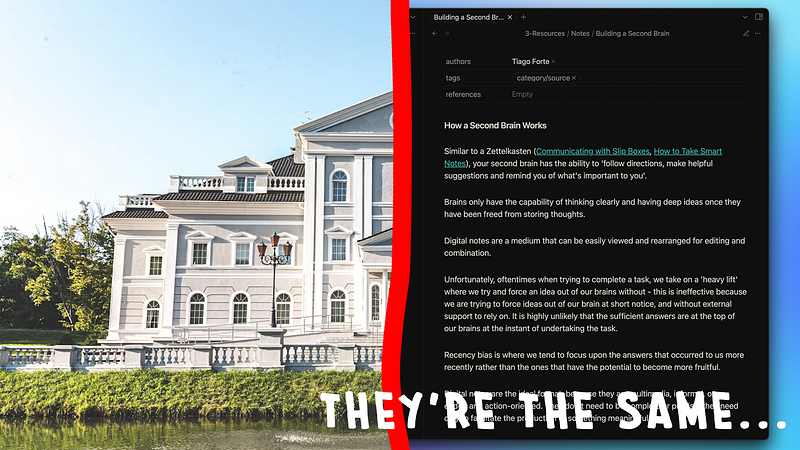
The other day, when I was writing my last piece about note-taking theory (specifically Minimal Note-Taking), a seedling of an idea began to form. An idea of comparing your note-taking system to a house or living space.
Now you don’t have to think twice about using your house effectively (even the phrase sounds a little stupid), so you shouldn’t have to think twice when it comes to managing knowledge effectively either.
I’ll use this piece to explain why…
Here’s the bottom line — even though it’s on a much smaller scale, your PKM system is like a home. You want it to operate correctly, do the right things for you and be a positive influence in your life, rather than a burden.
This being the truth, it astonishes me that so many people change systems and apps as often as they change clothes.
Would you ever consider moving house weekly? No? Treat your PKM system the same then. Make the decision patiently and logically, but once you’ve found a platform and system and settled down there, don’t bounce about.
There are reasons for this. Imagine you keep moving around the world, living in different places — it would be ever so hard to establish a proper rhythm, and your energy and decision-making would be spent just trying to survive to the end of the day.
It’s the same when you keep switching systems and apps. All your focus and energy goes towards learning how the app or system works, rather than doing any kind of sensible creation or knowledge processing.
Rather, when you live in the same house and the same location for a long enough time period, you can set up useful habits. Using your house, or your system, becomes second nature, and you can focus more on progressing your purpose in life rather than trying to keep everything from falling apart.
It’s okay to make changes but liken them not to moving to a new house in a new country, but rather storing something in your house on a new shelf. A much smaller tweak is better.
If you make a lot of these changes over time then you can end up with quite a different style of note-taking to what you started with, but the evolution has been sustainable.
You’ve felt as though you’re working in the same system every day, rather than alienating yourself every time you throw yourself into a new environment.
You’d dislike it if your house was too big or too small as well. It’s about finding a balance.
To small and not enough things in it and you can’t use it for what you have planned. No dinner parties — the kitchen doesn’t have the utensils to cook, and there’s no room to host the guests.
If your house is too large, however, you’ve got a full-time job on your hands making sure that it doesn’t fall into ruin. You won’t ever get to enjoy the benefits of being there because you’ve got too many things to keep track of, and so much clutter in the way that you’re not organised or aligned with your work.
Guess what? A note-taking system is the same.
Too many plugins, themes and snippets and you waste all of your time making sure that they ‘work together nicely’ (trust me, I’ve been there) and don’t break or cause disaster.
But there is something to be said about having a few powerful features that provide tangible benefits to your system…
In the context of myself and my own system in Obsidian, Folder notes and Dataview are two such community plugins that make my life much, much easier.
But you don’t want to go too far in either direction. The best system for your work lies on a spectrum in between too simple and too complex, with just enough features to help you work effectively, but without enough to confuse and distract you from getting the job done.
It’s like a house. You don’t want to be living in a single room, but you don’t want to have 25 of them to manage and maintain. Find the sweet spot, where you can work without constraint, and without distraction either.
What I’ve just described in the last part of this piece is the basic tenet of my principle Minimal Note-Taking.
Thanks for reading!