The other day I watched Tiago Forte (one of the, if not the most prominent name in personal knowledge management education) elaborate on how AI writes 90–95% of the volume of content in the blog posts that he’s been sharing recently.
Now although this is a brave admission, it rubbed a lot of people the wrong way, myself included (but I’m not address this fact by writing a knee-jerk YouTube comment tearing Tiago down).
My main criticism on this was that doing something like using AI to generate a style guide from his own writing and then using said AI-generated style guide to inform another AI in the blog-post-drafting process, doesn’t seem very aligned with the fact that Tiago is largely an educator around personal knowledge management.
Where exactly does PKM even fit in this process?
I’m not going to elaborate on my criticism in this piece, rather I’m going to give you a few ways you can tie AI into your PKM or content creation processes in a way that keeps the creative, manual writing and building at the forefront of how you spend your time.
First, let me just say that I don’t use AI very much in either of my writing or PKM, so you can take these suggestions with a grain of salt if you’ve already found more advanced ways of doing so.
It’s an area that I’m lacking in, because I’m certain there will be some corners to be cut effectively, minimising damage, but I’ve not gotten around to identifying them yet.
However I think there are some more tactful and…even though this is too much of a buzzword for my liking…ethical ways of going about this. These are what I’m going to be addressing in this piece.
AI editing suggestions
Instead of using AI to draft the contents of a piece that I want to share, I use it to help me edit. When I’m drafting, I’ve always typed, or more recently dictated, every single word.
This works because the writing comes from my head, and is therefore in my voice. I’ve gotten pretty good at keeping the likeness of how I speak and how I write consistent, so it all sounds the same no matter whether generated by fingers or by tongue.
Either way, everything is my own content, and AI only begins to play a part when it comes to refining the piece.
For these articles that I write to teach personal knowledge management, I have a specific prompt that I feed the draft through to throw up suggestions for writing edits that I might want to make.
And once these have been returned, I look at them and decide whether I want to include them. Normally it’s changes to the first few lines of the piece as a hook, or ironing out the convoluted structure and progression of what I’ve got so far.
Even after this, my primary editing solution is simply waiting for a few hours if I can, and then coming back to the piece and reading it through with a fresh perspective (I’ve found there are some funny errors that make it through if you just go straight to publish).
But sometimes the AI throws up some really good suggestions that aren’t in fact tailored to specific word or phrase changes, but more often positioning or structural changes that I can make.
I’ll emphasise as well that they’re suggestions, so I’ve still got to take them and manually complete the writing and editing if I want the change, as opposed to asking the tool to churn out the words for me.
Summarising project/topic progress in my PKM system
I’ve also been using a little bit of AI in a new method of tracking progress in my projects and general area folders.
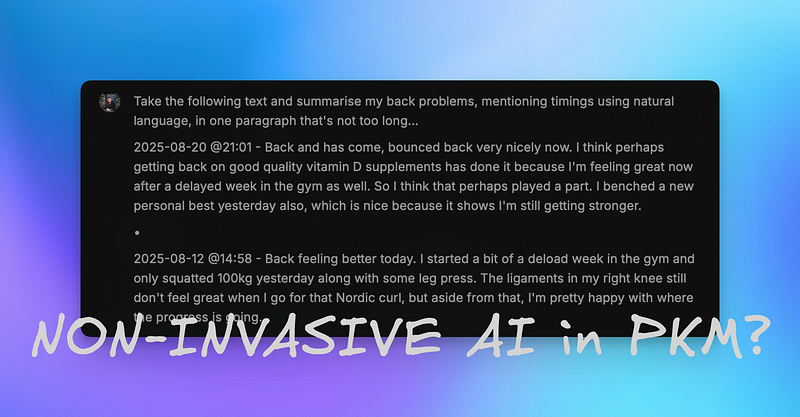
Inside the folder notes I’ve loved for ages, I’ve been capturing time-stamped portions of information around the topic or project that the folder relates to, updating my future self on how I feel about progress.
This is something that a physical journal could never do very well. It’s great for me calming down, clearing my thoughts and becoming more peaceful, but for any re-visitable progress tracking it doesn’t really work. Everything’s clumped together, with no topic or project differentiation, making it hard to isolate the information you want.
But if I capture topic/project-related notes into a folder note digitally, and at some point want to draw a conclusion from them, I can just ask AI to summarise my progress.
And although it’s not something I could (or would) use as my own content anywhere, it’s a functional recap of information that I could use to inform a piece about my back and how I’ve recovered it.
This means the writing ends up maintaining rigour and detail compared to if I’d attempted to recall this from my memory (I could resurface more detail about certain points, and quotes as well, if I desired).
Which, again, is useful and yet relatively non-invasive.
Back when I was studying for a degree in Zoology (from which I graduated very recently), AI had a more prominent role in my work.
There were long papers to summarise, and I used it to poke holes in the structure of thought in my own writing. But this was always as a sparring partner for my reasoning, rather than as a co-author.
And when I needed certain features in my figures, I used AI to write the code. But not before I’d chosen what I wanted the figures to look like and put together a rudimentary version myself.
There are a few other very minor things that I’m using AI for at the moment, like adding UTM parameters to links that I’m pasting into content, but nothing major aside from summarising things and suggesting edits.
Perhaps it’s a problem on my part — perhaps I’m being naive by grasping on so tightly to doing every single part of my creative workflow manually. But as of right now, I’ve not seen any artificial tool that can do a job that I’d be satisfied with. So we’re sticking with not using it.
I do think going about AI use in the form of rubbing it in the faces of your readers who want to feel a personal connection with what you’re saying (as Tiago seems to have done in his video) is a miss.
This my two cents on a couple of ways AI might be used in a less invasive and more tactful way. I hope it’s given you some food for thought. Thanks for reading!