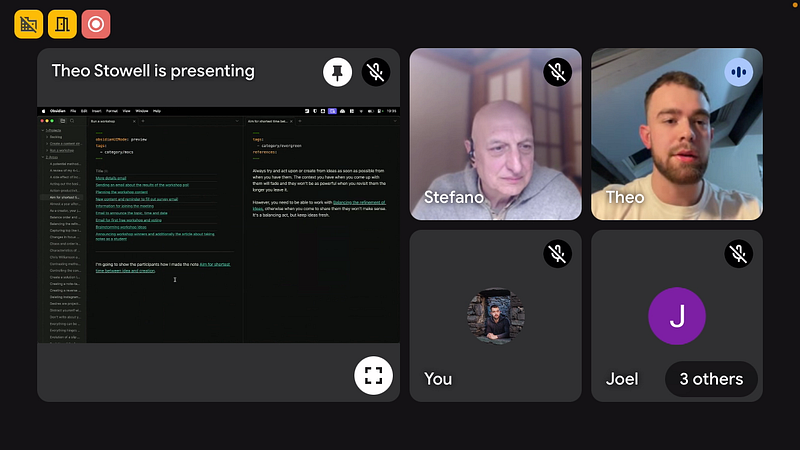
I’d been wanting to host a workshop for a while but had been putting off the task due to uncertainty. The first step in fixing this was to send a date to my email list so that I couldn’t back out of the process.
So I did, after gathering some preferences around days, times and subjects. I set it all up, got through the procrastination, and delivered last Friday.
Before I go into what I learned from the experience (in short — a lot), I’m going to give you a run-down of what we covered in the ~50 minutes I was presenting for…
1. Capturing inspiration from the external world
We’re all aiming to come up with and share creative work of our own, but the truth of creativity is that it’s best enhanced using quality sources of inspiration from the external world, combined with what experience and knowledge we have internally.
To make this work, you need methods of capturing inspiration when you come across something interesting in your day-to-day life. The best advice I have for this step is as follows…
Keep it unrestricted. The temptation is to have concrete rules that you use for capturing information, within a single capture inbox. Be a little looser instead. It doesn’t matter what you write, or where, so long as in the future you can refer back to this point of inspiration and act upon it.
Bearing this in mind, I recommend methods of capture in the main places you encounter information. Don’t have too many, or it becomes complicated. 99% of my inspiration capturing happens in three places — my Obsidian inbox folder, my physical passport-size Traveler’s Notebook or my Todoist inbox.
You can also use various services to automate some of this process, which is useful. Readwise is a popular option and the one that I’ve chosen almost since I’ve been maintaining a vault in Obsidian. Omnivore is the best free alternative to this that I’ve come across.
When you have time, go back through these places of inspiration and organise or standardise the information there so that it better fits inside the applications of your system.
That’s where the next step comes in…
2. Generating and nurturing ideas
Once you’ve found your inspiration and captured it within your various buckets, it’s time to work on the inspiration to come up with more fleshed-out ideas that can then be used (discussed in step 3).
For this, I use a Zettelkasten in Obsidian. Within my system PARAZETTEL, I can join together related idea notes using in-context backlinks. This creates a digital web of thought that mirrors the unwritten knowledge in my head.
This web is then always available for me to browse for inspiration to take forward into the creation stage. The links between notes create a logical path for the progression of ideas (some are almost two years old, and provide valuable insight into the changing landscape of my mind).
When I come across something within the Zettelkasten worth sharing, I head to the next step…
(It’s worth noting that some ideas come to you ready to execute. In this case, it’s not required to carry out the current step — you can take the idea straight to step 3.)
3. Executing your ideas
You can use the high-quality ideas that result from Zettelkasten use in almost anything. The example I used in the workshop was content creation, as this is what I do most with my knowledge, but applications in self-development, study and business are common.
I demonstrated the use of my system to write a tweet in the workshop, taking the idea that I developed in my Zettelkasten in real-time, in front of the onlookers. I use a similar process to outline longer articles too.
There’s no set way to use the ideas that you come up with, meaning I can’t write much for this section. It’s on you. That said, I’m going to go on to what I learned in running this workshop…
Takeaways from hosting my first workshop
It’s not easy to connect personally to who you’re impacting when you run an online presence similar to mine. However, I’ve learned that it’s really valuable when you do.
Having people tell me live, in-person that they use PARAZETTEL is in a different league to seeing purchase notifications in your email inbox.
As well as this, it’s so fulfilling to see people’s faces when you’re explaining something. The nods of understanding, the smiles of agreement.
I was aware of the great importance of genuine human connection. Less so of how my online audience could be part of this too. I’m going to be doing many more workshops like this from now on.
So that’s the low-down on what went on last Friday, and what I learned.
If you want more, you can get free access to the entire recording by signing up for my mailing list. This is also where I’m going to be releasing details on further workshops, so head on over if you don’t want to miss out on this.
Thanks for reading!